

Creative Magic: Twenty-Three Fun & HUMAN Ways to Transform Your Lackluster Draft
Or create a whole new story out of thin air!

Hi friends! I hope your writing is going well and you’re managing to stay cool. If you’re like me, you have a few flash drafts in your folder that you keep returning to in hopes of making them work. You know there’s potential there, but you just can’t seem to bring it to fruition. Some writers are now turning to AI for “help” with their writing projects. I can’t fathom getting any satisfaction from that. You probably can’t either. That’s why you’re here!
Today, let’s remember that the struggle of writing, the working through, the trying and failing, the horsing around and experimenting, is also what makes it so rewarding. Why hand it all over to a machine? What follows are twenty-three tricks for vivifying a draft that’s not quite “there” yet.
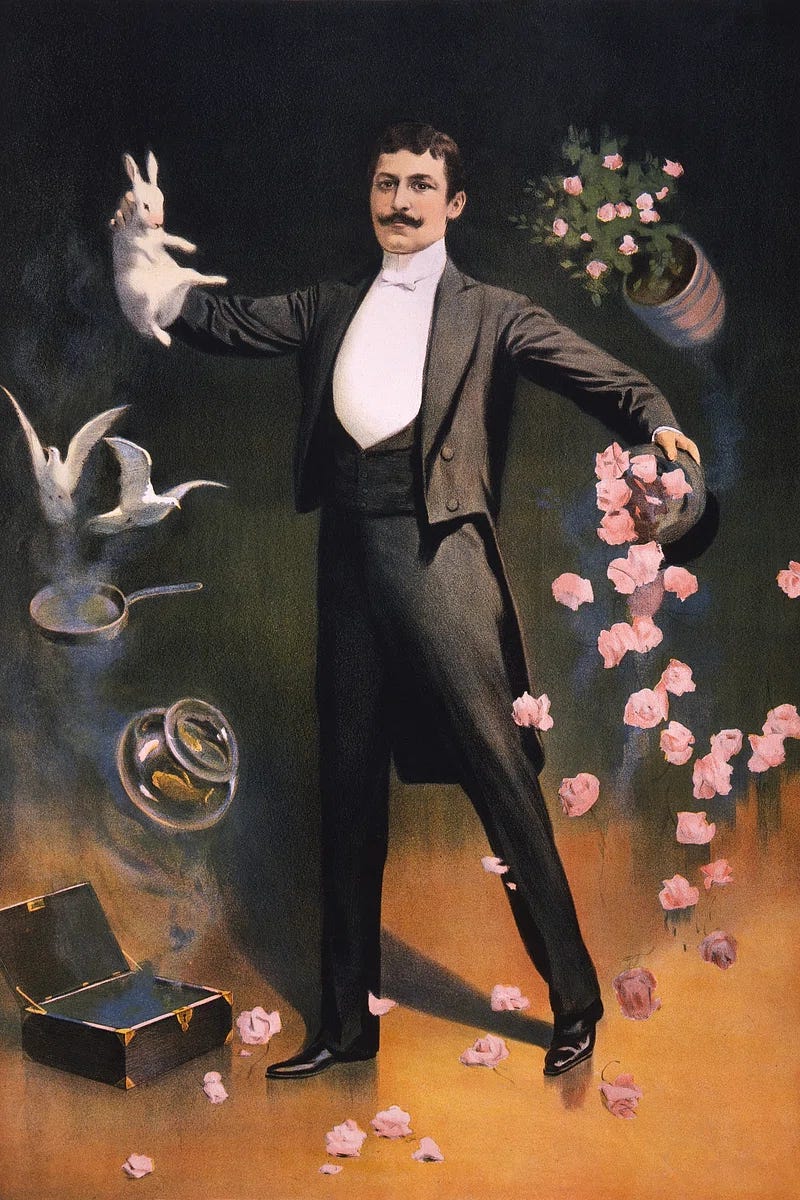
This sort of creative play is not pulling a rabbit out of your hat, though it might feel like magic. To watch your writing transform into its highest expression of you, an utterly human piece of art , is deeply satisfying and soul-growing.
I’ve made this article (originally published in 2023) free and open to the public, so if you enjoyed it, please feel free to share it! Many thanks, ~Kathy
Throw in an animal. Joy Williams, in her “Eight Essential Attributes of the Short Story and One Way it Differs from the Novel” says a short story must include “an animal within to give its blessing.” Animals can be unpredictable. Include a peacock in your story and see what happens.
Slap a title on that thing. Preferably one that does not, in any way, support the current draft. Now write into it. Let it inform your revision. Be bold in this. You can also start from a title alone: “The Last Time [So and So] Did [Such and Such]” or “My Life as a [Article of Furniture].”
Include an Unexpected Detail. Those who’ve taken my workshops are familiar with this exercise. This can be a Particular Object or it can be, well, anything. What happens to your story if you throw in some unexpected kindness, for example? Indeed, what happens in life?
Get boldly weird in your descriptions. Compare a smell to a sound. A color to an emotion. See how this gives your subconscious permission to think outside the box in other ways.
If you’re thinking, “no one will publish this” lean even further into the idea.
Forget the template in your mind.
Forget what the writer on Substack admonished you against. Especially if it was me.
“Poem-ize” your prose. Break it into stanzas. Create line breaks. Pull out anything but the most essential images, the most powerful language. (I learned this from Maureen Langloss, editor-in-chief of Split Lip Magazine, who offered this gem up years ago on Twitter, as if to say, “here’s something you can do,” my favorite kind of writing advice.
Similar to #8, pull your paragraphs apart and create one sentence paragraphs and see what lives in the white space. I do this one a LOT as a means of “re-visioning” my story. Breathe some air into a breathless paragraph.
OR chunk up your short paragraphs into one breathless paragraph and see what taking the air out does. For all of these, read your piece aloud, before and after. Which version best serves your intention for the story? Compare the experience of breathlessness vs. the sort of collaboration required of a story full of white space.
Add a minor character who “sees” the story more clearly than the others.
Remove the first and last paragraphs entirely. Now what?
If your story is in first person, remove all instances of the word “I.” (This is HARD, but really changes the movement of the writing.)
All questions.
All exclamations.
All declaratives.
All objects. (Keep at these until your subconscious supplies a pattern. Our brains are story-seeking machines if you get out of their way long enough.)
Try pouring your story into a new container. A list? A hermit crab?
Print out your story. Cut up the paragraphs. Move them around.
Begin with the sentence: Bear walks into a bar. Go!
Hunt for the “why” of your story. Lucy Cron, in her article, “Tell Don’t Show? What Brain Imaging Reveals About Readers,” examines the work of neuroscientist Steven Brown. “According to Brown, when we’re grabbed by a story, we’re instantly making inferences about the protagonist’s beliefs in order to pinpoint their intentions and what is motivating their actions. We’re not hooked by what the protagonist is doing; we’re on the hunt for why they’re doing it.” This is part of the fun of reading!
Mad Lib it! One of my all-time favorite flashes is Madlib by Kim Magowan in Okay Donkey. I create my own “fill-in-the-blanks” stories when I have the ghost of an idea but am bereft of details. Use this framework to plug things in without overthinking until something sticks.
Reverse the chronology. How does that change the emotion of the story? See Stephen Dixon’s phenomenal “Wife in Reverse.”
Thanks, as always, for stopping by! This article is open to the public, so please feel free to share, or leave a comment or question below. And if you’re not already subscribed, consider joining the Art of Flash Fiction community. We’d love to have you.
Great ideas. Such a fan of Joy Williams, whose work was really influential to me when I was in grad school. I love seeing her on this list.
Thank you, Kathy. What a generous list of magic revision potions!